Gerd Butzeck in the Race for IHF President: “Handball Deserves More”

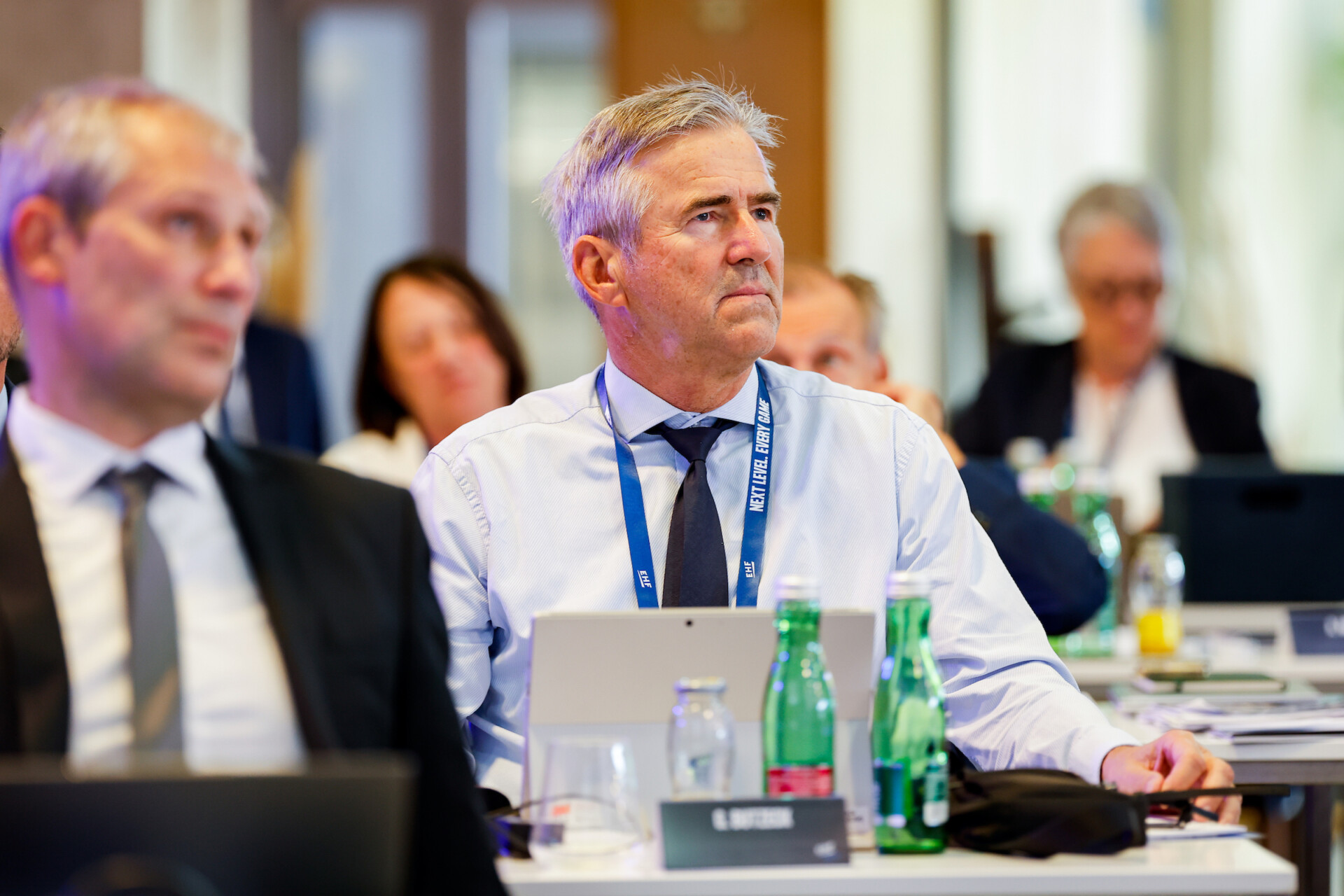
The International Handball Federation (IHF) will elect its leadership in Cairo during Ordinary Congress at the end of December for the upcoming term. The most important part of this global handball gathering will be the election of the IHF president, which will clearly determine the direction in which the sport will develop in the coming years.
Since 2000, the position has been held by 81-year-old Egyptian Hassan Moustafa, who announced that he will run again. A few months ago, a candidacy came from Germany, where the DHB nominated Gerd Butzeck – a well-known figure in the handball world and longtime leader of the Forum Club Handball, the umbrella organization of Europe’s top clubs.
The 66-years old Butzeck will present delegates worldwide with his vision for the future of handball, under the slogan “Handball Deserves More”. We sought to learn what exactly this entails.
Let’s begin at the very start. How did your journey in handball begin?
– I started as a referee when I was 14 years old. I was a player first, and then I became a referee. I was also quite good at chess. Honestly, I wasn’t good enough to be a high-level player in handball. Maybe I could’ve reached the second division if I had tried, but definitely not the first. So I chose refereeing. By the time I was 25, I became the youngest-ever referee in the German Bundesliga. And a year later, at 26, I was the youngest-ever full-time manager in professional handball in Germany. A club with some very big names—Mile Isakovic, Erhard Wunderlich, and coach Zdravko Miljak. Maybe those names ring a bell. We also had Jan Holpert, a young goalkeeper at the time.
An important part of your career was in Russia.
– While studying in Russia, I met the Soviet national team by chance and we became friends. I started organizing things for them in Germany and found them sponsors. Then the Soviet Union collapsed, and the players wanted to move west. I helped them and eventually built a company. I stopped managing a club and started a players’ agent instead.
So that’s how your career as a player agent began?
– Exactly. I first managed the Soviet team, then the Community of Independent States, and later switched to the Belarusian team. From 1992 to 2002, I was the Vice President of the Belarusian Handball Federation.
You were also involved in the beginnings of beach handball?
– Yes, funny story. Around 1999 or 2000, I was with Spartak Mironovich, famous coach from Champions League winner SKA Minsk, in Israel. I told him there’s this new sport called beach handball. He asked, “What is beach handball?” And I said, “I have no idea.” But six months later, Belarus became the first European champions. Then we went to the Akita World Games in 2001 and became the first world champions. I became a beach handball delegate, helped develop the competition system we use today, and continued as a player agent. Over my career, I’ve mediated the contracts of around 350 players. Talant Dujshebaev, one of the most famous. Also Kyung Shin Yoon from Korea, Nikolai Jacobsen, Sascha Tuchkin, Andrej Lavrov, Alexandr Karshakevich, Iouri Shevtsov. On the German side—Jochen Fraatz, Stefan Hecker, and “Blacky” Schwarzer, whom I transferred to Barcelona. I also transferred Henning Fritz from Magdeburg to Kiel. I’ve built good relationships with most players I worked with. I focused so much on Russian players, since I speak the language. Even Bob Hanning was one of my clients around 2000. I transferred him several times—from TuSem Essen to Solingen, then Wuppertal, Willstätt, Hamburg, and eventually Berlin. Funny enough, Berlin had actually offered me the job of manager of Füchse Berlin in 2004, but I turned it down because I was offered the manager position of the German League. So I recommended Bob for the Berlin role instead.
2006 was a milestone year for handball…
– A year 2006 was a big year for handball. Three major changes happened. First, the EHF centralized marketing, taking control away from clubs, who used to sell their TV rights themselves. Second, the European Championship qualification format changed from play-off to group system. Third, the IHF introduced qualification tournaments for the Olympics. The president of the German League at the time, Bernd-Uwe Hildebrandt, said we needed an organization like football’s G14. He asked me to create it. That’s how Group Club Handball started. In 2011, we transitioned it into Forum Club Handball—more open, with every club having the chance to join.
How has governance evolved since then?
– The EHF really improved. There’s transparency, communication, and inclusiveness. Unfortunately, this wasn’t the case with the IHF. In 2007, I had a conversation with Dr. Moustafa, and he told me, “The clubs don’t exist for me.” And it was true—according to the IHF statutes, clubs didn’t exist.
That must’ve made cooperation difficult.
– Exactly. If you wanted to speak to the IHF, you had to go through your national federation. They would pass on your message, get a reply, and send it back. Of course, this system didn’t work. Only in 2017 did the IHF finally sign a cooperation agreement with Forum Club Handball. It was a breakthrough. That agreement was extended in 2022 and runs through 2026.
Where do you see room for improvement in world of handball? There are some fields where, for example EHF, “reach the sky” with Final4 events…
– That’s the right question. My campaign slogan is going to be “Handball Deserves More.” But you’re also right: in some areas, we’ve hit limits. Look at Cologne or Budapest—these arenas are full. You can’t do much more there. You can raise ticket prices, but you can’t improve the core product. So to grow, we need to go outside Europe—China, India, the USA.
And how do the rules of the game factor in?
– They’re too complicated. I’ve refereed nearly 1,000 matches, and even I say that. Spectators don’t understand what’s happening, especially with video reviews. We need multiple versions of the rulebook: a two-page version for beginners and teachers, a simplified 25–50-page one for semi-pros, and a full version for professionals and referees.
What is the biggest issue for them?
– When to raise the arm to announce passive play. It’s a tough call. It could be solved easily with a short clock. The Soviet Union tested this in 1990—they had a shot clock system. But the IHF didn’t want to adopt it. I once asked President Hassan Moustafa why, and he said, “We don’t want handball to look like basketball.”
How do you describe your leadership style?
– I’m not a specialist in coaching, refereeing, or marketing. I’m a globalist with wide experience. I’ve been at the table for over 100 European Cup matches and six European Championships, including the 2000 men’s final between Russia and Sweden. I know how things work. My role is to find the best experts and let them shine.
Development in the U.S. has often been criticized; year by year nothing significant has happened.
– That’s a problem. The U.S. Handball Federation hires people from triathlon or wrestling through agencies and makes them CEOs. Then they’re surprised when nothing works. It’s obvious to me—this is not how you build a handball culture. In 2017, Hassan Moustafa asked the Forum Club Handball to support U.S. handball. We brought six players to Europe, paying clubs €2,000 per player per month. Over seven years, the U.S. improved drastically. In 2023, they won their first World Championship match. In 2025, they even drew with Poland. That was historic progress. Imagine now a program where we support 50 players globally. €2,000 each, that’s around €1.2 million a year. For the IHF, that’s affordable. Clubs benefit, young players benefit, and handball benefits.
How have people reacted to your ideas?
– Extremely positive. In Europe, maybe 90% of nations support me, with just a few exceptions. The biggest surprise was the positive reaction from Africa and Asia. People there say it’s time for change, time for a restart. Since the launch of our website www-handball-deserves-more.com some weeks ago we had so m many positive comments.
What’s the single most important step for handball’s global growth?
– A strong relationship between the IHF and EHF presidents. Europe will always be the locomotive, but the future lies in developing handball beyond Europe. If we want real growth, we need to build in the U.S., India, China, and beyond. That’s the global message – concluded Butzeck.
Mandatory Credit © Uros Hocevar / kolektiff











Pingback: Hanning praises Moustafa, Michelmann pushes reform | Handball Planet
Pingback: Handball Planet: Gerd Butzeck in the Race for IHF President - Handball Deserves More