MIJAJLO MARSENIĆ JOINS FÜCHSE BERLIN IMMORTALS: His jersey will become the sixth under the roof of Max-Schmeling-Halle

Mijajlo Marsenić will leave Füchse Berlin at the end of the 2026/27 season after nine years with the club, but his name will remain forever inside the Max-Schmeling-Halle – the Serbian line player’s jersey will be raised to the rafters as the sixth in club history.
The news about Marsenić’s departure was announced ahead of his ninth and final season in Berlin. Since arriving in 2018, the Serbian international has become one of the symbols of the most successful era in Füchse Berlin history, and managing director Bob Hanning confirmed that he will receive one of the club’s highest honours.
“He is a great athlete and a great person. We will part as friends for life, and since his jersey will be raised under the roof of the arena as the sixth player, he will always remain visible to us and to the fans,” Hanning said.
Marsenić will therefore join an extremely exclusive group of club legends whose jerseys already hang under the roof of Max-Schmeling-Halle.
Before him, that honour was given to Diethard Finkelmann, Petr Stochl, Iker Romero, Hans Lindberg and Paul Drux.
Finkelmann and Stochl – the beginning of the legends gallery
The club’s “Legends Gallery” was launched in 2013, with Diethard Finkelmann and Petr Stochl becoming its first members.
Finkelmann represents the historical roots of Füchse and Berlin handball, while Czech goalkeeper Stochl became one of the symbols of the club’s modern rise and return among the strongest teams in Germany.
Iker Romero – the man of the first major trophies
The third jersey raised to the rafters belonged to Iker Romero, number 18.
The Spanish star arrived in Berlin as an established world-class player, but quickly became much more than a big name. As captain and one of the team leaders, he helped Füchse win the DHB-Pokal in 2014 and the EHF Cup in 2015, during the period when the club firmly established itself on the European handball map.
Hans Lindberg – goals, records and trophies
The same number 18 was later worn in Berlin by Hans Lindberg, another icon of Füchse’s modern era.
The Danish right wing was one of the faces of the team from 2016 to 2024, won European trophies with the club and became the all-time top scorer in Bundesliga history.
His jersey was raised to the rafters as recognition for eight years in which he became one of the most important figures in the club’s history.
Paul Drux – a true product of the club
The fifth member of this select group was Paul Drux, whose number 95 perhaps best represents the philosophy of Füchse Berlin.
Drux came through the club’s youth system, became a German international, captain and one of the biggest identification figures of Berlin handball.
His playing career ended prematurely because of injuries, but his status as a club legend was never in doubt.
Marsenić – nine years of a golden era
Marsenić will now become the sixth.
He joined Füchse Berlin in 2018, and by the time he leaves in the summer of 2027 he will have completed nine seasons in the green jersey.
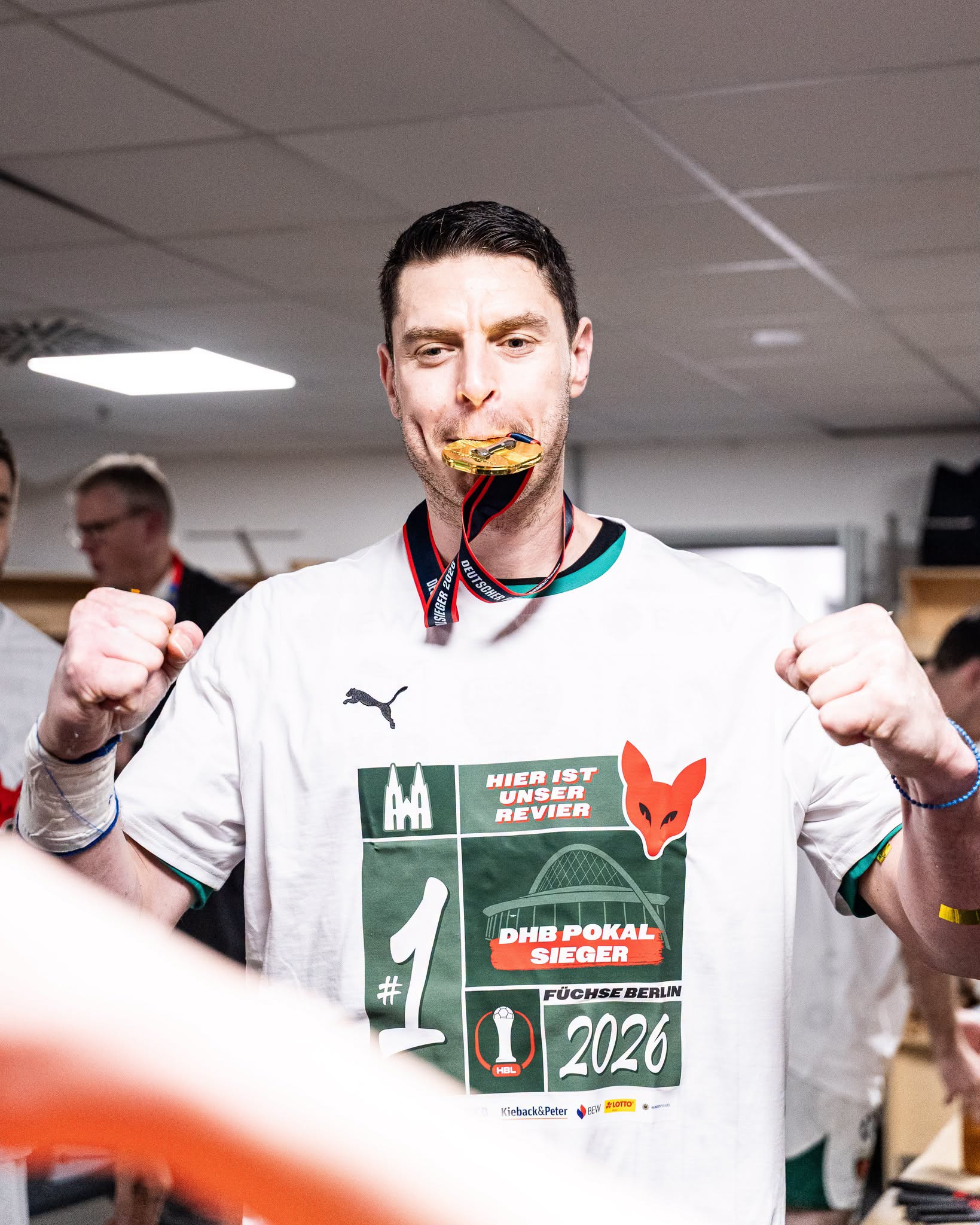
With Füchse he won the EHF European League in 2023, the German championship in 2025, the DHB-Pokal in 2026 and two German Super Cups – in 2024 and 2025.
Still, his importance to the club cannot be measured only through trophies.
Füchse have repeatedly described him as a player who brought enormous energy to the team and the stands, a leader on and off the court and one of the central figures in the dressing room.
Hanning described Marsenić as a club institution and one of the key integration figures of the past decade.
That is why, from the summer of 2027, six names will stand together under the roof of Max-Schmeling-Halle:
Diethard Finkelmann.
Petr Stochl.
Iker Romero.
Hans Lindberg.
Paul Drux.
Mijajlo Marsenić.
Six players from different generations – and six names that tell the story of how Füchse Berlin grew from a traditional Berlin club into one of the leading forces of German and European handball.
PHOTO: Fuchse Berlin