Žika Bogdanović BLOG: Being There to See It — EHF EURO 2026 and Denmark’s Triplet Moment

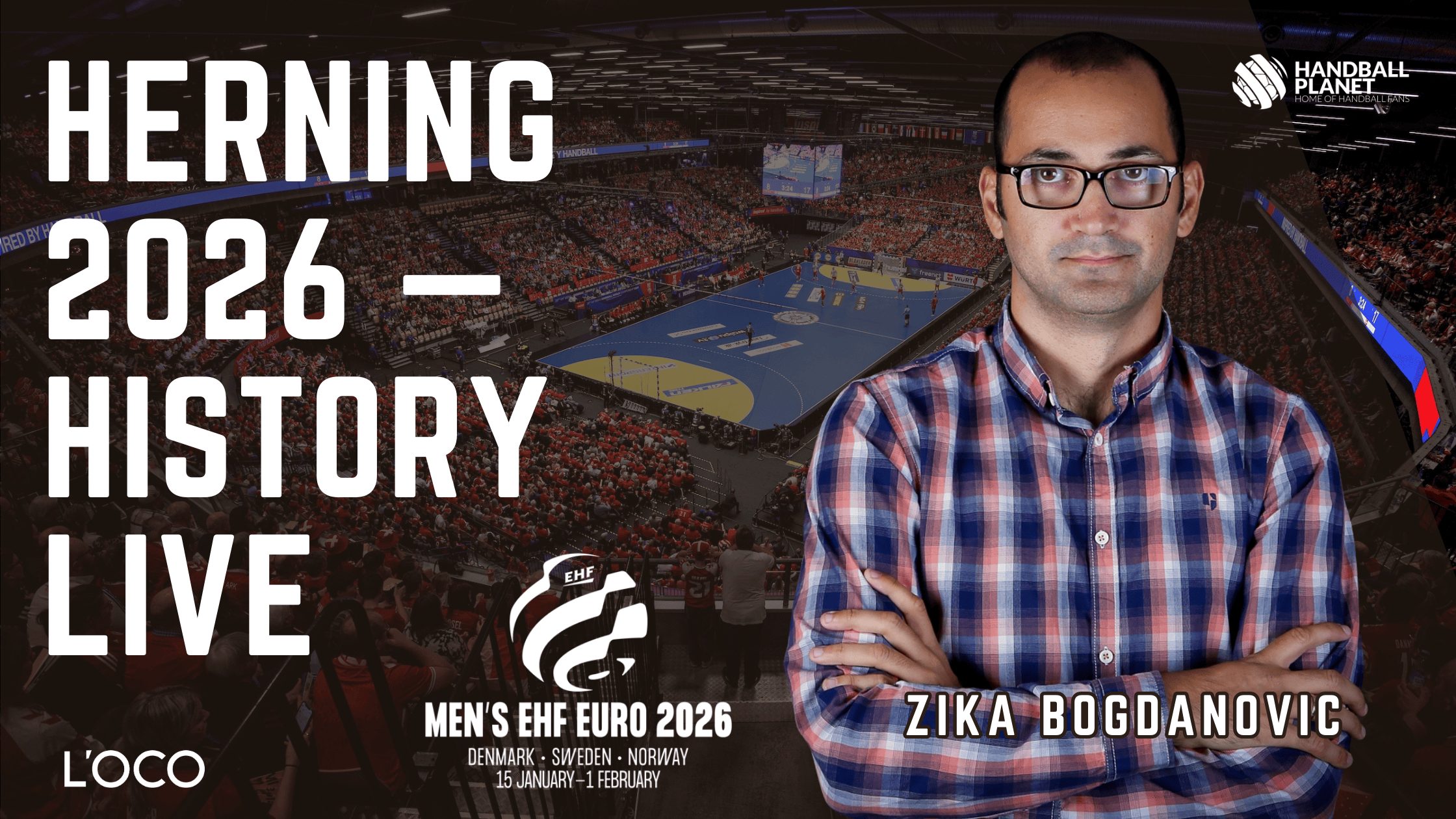
The greatest truth is that history is always being written right in front of our eyes. Sometimes we’re aware of it, but most of the time we aren’t. All of us who follow handball can sense that Herning 2026 should be that “being there and seeing it” moment—when Nikolaj Jakobsen finally completes the “triplet,” when Mathias Gidsel rounds off everything there is to round off with the national team, and when Denmark confirm that even at the toughest tournament—the European Championship—they can ultimately win.
Every era brings its own story, but if they do win, the question “Who is the best team of the 21st century?” will gain real weight—because France from the end of the first decade, from Zagreb 2009 to Qatar 2015, will finally get a true competitor. And we used to think that would never be possible, or at least not for the next 50 years. Denmark has earned everything that’s happening to them, and even though it’s human nature to root for the underdog, that “triplet” should make anyone who loves handball happy.
That’s sport: every day, new kids are training somewhere; some GOG—or a similar factory—is tuning up a new batch of blond boys with dreams of their own. Great players move into legend, and they’re replaced by new ones we first watch cautiously, holding back judgment—until, as the years pass, we become fully aware of their greatness and their incomparability to the giants who once seemed the greatest.
That’s exactly what happened with Mathias Gidsel. Regardless of the fact that he doesn’t have an EHF Champions League trophy, nor the EHF EURO “plate,” he has taken his place among the “aliens,” in that VIP booth where, among those born in years starting with a 2, Nikola Karabatić, Mikkel Hansen and Ivano Balić sit, raise a glass, and toast the new master.
Mathias Gidsel has changed handball—erased positions, redefined what it means for a player to be complete. Just as importantly, he has continued the line of “good guys from next door”: the biggest stars who are approachable to fans and media, which is part of what makes handball recognizable and easy to love.
And when we thought Šterbik and Omeyer were something that would take time to be repeated, they proved us wrong—first Niklas Landin, and then Emil Nielsen, who has the door wide open to stand shoulder to shoulder with the immortals.
The handball map in the new Olympic cycle is undergoing subtle changes. While people think only France has no Denmark complex in the handball world—and they’ve shown it more than once—Alfred Gislason is patiently building a new “world power” that won’t need wild cards, home stands, or referees to help it along.
Germany already have an unbelievable number of young players, and in terms of completeness across every position, they are right there next to Denmark. By all the rules of probability, the Germans should win gold in the coming years—their first since EHF EURO 2016 in Poland. Six guys from the golden 2002 generation are already in, and just a little older are Knorr and Köster, alongside Wolff—on paper, that looks terrifying.
If we look at it futuristically, the French could keep winning, and the Germans could end up ruling—if Denmark, by some chance, stop riding this wave. And all signs suggest that won’t happen any time soon.
Sweden, with masters like Cllar or Palicka, always defensively impeccable, hosting in Malmö, and with a huge imbalance in the quality of the main-round teams compared to Herning, should reach the final weekend.
We’ve been waiting for that Iceland for years. We waited a decade for Aron Pálmarsson to confirm his world-class status, to say “I’m number one” with a national-team success—but it never happened. Now that role belongs to Gísli Kristjánsson. We watch Magdeburg and ask ourselves: “How is it possible this isn’t a world power when it has players like that?”
The draw and the road to the final weekend in Herning are as easy as they can be, and it’s hard to imagine they’ll get such a chance again any time soon. It’s pointless to talk about their quality—but whether they’ll finally transfer all of that from club level to the national team, we can only guess.
I hope the Hungarians have recovered from the trauma in Zagreb, when they threw away the World Championship semifinal in the final five minutes against Croatia. Chema Rodríguez has built a national team whose finish—from fifth to eighth—could be used to set your watch. Hungary are on the “weaker” side of the bracket; a match with Iceland could become an elimination duel right at the start in the race for the semifinals.
What they lack are superstars who can go beyond the limits of the possible. There are so many products of the Hungarian handball system—one that much richer countries would envy—but they’re missing that one who is born, not made: that X factor.
The Costa brothers are a phenomenon; Salvador Salvador (someone must have branded this guy like a movie star—there’s no chance that’s his real name), Iturriza, and all those guys. Still—who can say Portugal will be ahead of France and Germany in a semifinal? And where do the Spaniards fit, the team with the biggest swings in world handball, led now by the longest-serving coach around—Jordi Ribera?
From the first phase to Olympic bronze and back again, the generational shift in Spanish handball is turbulent. The road from golden cadets to golden seniors is long and uncertain. It takes time—and when you look at the side of the bracket where “La Furia” are, it also takes luck.
I can vividly bring back that feeling from Bercy in 2017, when I asked Bjarte Myrhol in the mixed zone after the match with France—rhetorically—when the Norwegian time would come. A medal at EHF EURO 2016, a World Championship final in 2017, the young Saugstrup, Reinkind, Bergerud—speed, power—it was only a matter of time before second and third places would become first.
How it all collapsed in the years that followed, and why it happened—I hope the Norwegian federation can do a serious analysis and provide answers. What prevented those guys from reaching their full potential, and why today nobody takes them seriously when the podium is discussed? Was Kolstad the last chance, or the final shattering of the illusion that Norway could do what Denmark built?
The post-Duvnjak era in Croatia will be interesting for more than one reason. One is how they will fill the void left by the legendary Dule—as a player and as a person. The other is about the result itself—because January 2025 and that final against Denmark in Oslo felt, in most handball minds, like something outside reality.
Can Dagur Sigurdsson’s guys refute that—can they, on the basis of the cult status this team undeniably has and nurtures, string together TOP 4 results? Luck in the draw; the road will likely run through Malmö; and in clashes with Iceland, Hungary, Slovenia—there are certainly chances.
Slovenia are without several backs with serious EHF Champions League mileage (Zarabec, the younger Janc, Vlah), but their first seven still include two Barcelona players, then Kielce, Szeged, Gummersbach. The brilliant Slovenian school reached its peak in Paris, where they were one goal away from Denmark in the semifinal—and despite all their problems, nobody should write off Zorman and his guys.
And then there is the color and the true strength of European handball: teams like Austria; Serbia with Raúl González; the “flying” Netherlands; tough Montenegro; the Faroe Islands with half the country in the stands in Oslo; Italy with Bob Hanning; Czechia; Poland searching for a way back to life; North Macedonia, where the living legend Lazarov is doing an excellent job.
All of them with their ambitions and dreams—hungry to surprise, to reach places they once weren’t, or some have never been at all.
That is the real strength of European handball.
Enjoy handball. This is our month.